The Market that Feeds New York
Early morning dispatch from New York's largest produce market.
straightupjac
·
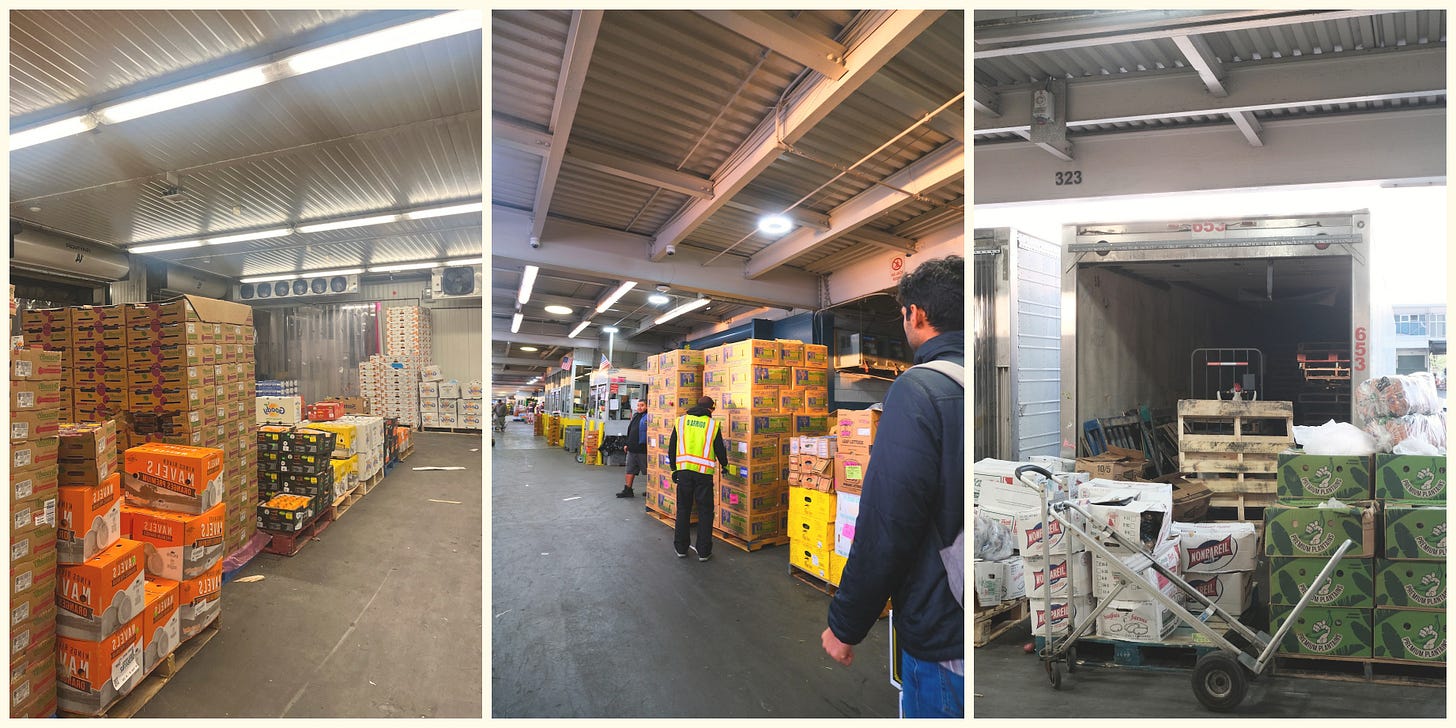
On Friday morning, I wake up at 4 am to get to Hunts Point produce market — home of New York’s largest fruit and vegetable distribution center. It supplies the city’s grocery stores, bodegas, fruit stands, and restaurants.
Public transit to the Bronx is sparse at this hour. As we pull off the highway at 4:30 am, the streets are full of activity. Trucks line the sides of the road, waiting their turn to enter one of three distribution centers; fruit and vegetables, meat, and seafood. Bus stops have people queued up. While the rest of the city is sleeping, this corner of the Bronx is coming down from another buzzing night.
✦ ✦ ✦ ✦
I first heard of the distribution center after reading about how New York’s apples move through it. I was mesmerized by how a singular physical trading post could handle the throughput to feed one of the largest metropolitan areas in the world.
Hunts Point is home to a few food distribution centers, with the produce market being the largest.
Across the seafood, meat, and produce markets, over $13M of product is traded every morning. The center moves 4.5 billion pounds of food annually, feeding the 22 million people in the NY metro area. The market was originally located in downtown Manhattan but moved to the Bronx in the 60s, clearing space to make way for the Twin Towers.
✦ ✦ ✦ ✦
My taxi driver and I circle the immense terminal, surrounded by tall walls. He drops me off at an intersection and I walk toward it, tracing the perimeter until I find an industrial steel turnstile. I try it and predictably, it needs someone to badge me in. I make eye contact with a man in a bright orange vest. He asks if I’m trying to get in and badges me through.
Inside, 18-wheelers maneuver in and out of the terminals, flanked by Range Rovers and rugged pickup trucks. 600–800 trucks move through the produce center a day. Some wait outside the complex for hours before getting a slot to unload. I’m starting to wonder if I’ll get run over.
✦ ✦ ✦ ✦
The Bronx is the only NY borough that doesn’t require a bridge to access from the mainland US, making it an ideal trading post for a high volume of trucks. When the market was first relocated to Hunt’s Point, city planners expected a substantial portion of produce to arrive by rail. Rail lines connect Hunt’s Point to Canada and the continental US but the interstate highway system rapidly shifted the entire logistics network toward trucks, which now dominate.
Many trucks do not have a formal queue or appointment system. They can wait idle for hours if they are not part of the fleet of large grocery stores who get first dibs. There are accounts of fist fights1 breaking out between drivers waiting their turn.
Vehicular congestion has grown over the years as trucks have gotten larger, choking out the smaller vans of other customers. These days, bodegas and smaller groceries are pushed to the slower hours after sunrise. They bid for whatever produce remains once the large grocery-chain trucks have had their pick — if they haven’t been pushed out of the market entirely.
✦ ✦ ✦ ✦
I’m walking along the terminal: on one side, pallets stack head-high with produce, lining a row of loading dock doors that mechanically rise and fall with a pressurized thud as people move in and out of walk-in refrigerators. I can hear the suction-seal sound of cold air fighting to stay in. The openings to each “produce stand” look like concession booths at a stadium. Salespeople are barking prices into phones and hawking wholesale crates. Shrink wrap spins around pallets taller than me before they disappear into truck beds backed flush against the terminal. We are there toward the end of market hours; by 5:30 am, most sales are wrapping up, the last few batches of customers are moving through. You get a sense pretty quickly that this place doesn’t wait for anyone.
We walk into the first booth with an open door and approachable faces. It is barely wide enough for two people to stand side by side between the long counter and the glass wall. A couple of middle-aged men work the phones behind it, clearly mid-deal. Berry, kiwi and peach samples line the shelves.
The salesperson closest to the sliding door asks what brings us in. “Just visiting,” we said. He smirks, “you can’t just visit Hunts Point, you have to know someone to be visiting.” We laugh. Fair enough. Once he realizes we are just two cityfolk curious about the market, he delights in sharing more about how they run things.
The salesman’s name is Gary. At 19, Gary’s dad dropped him off at the market and told him it was time to start working. School was never his thing.
“You can’t go to school to learn this business, you have to live it.”
To our surprise, he offers to show us the back. We follow him into the cold storage, which smells of berries, and he hands us cherries to taste*. “Guess how much this crate costs.”* We have no idea. “We’re in the middle of spring, peak cherry season. $85.”At that price, in a room stacked floor to ceiling, across five terminal rows, the market is moving nearly $6M of product a day.
Gary has tasted everything that moves through this warehouse. It varies year to year — some seasons the cherries are sweeter.
“You have to taste it to know if it’s worth the price.”
Thirty years into the business, he knows everyone who matters. The big grocers don’t bother walking the market — they call in orders and send their truckers. The smaller ones come themselves, moving row by row on foot, comparing prices, haggling. As we walk, Gary breaks away every few minutes to shake a hand or greet someone by name.
We stop at a lopsided pallet. White cherries. Guess how much? $140. There are about 9 bags in there. Some customers move so fast through the morning rush they don’t bother re-stacking what they don’t buy. For delicate premium fruit, a shifted crate means bruising, split skin, a product you can’t sell. Gary shrugs. “They’re customers. Sometimes, you just got to eat the loss.”
Gary maintains a mental map of the cold storage floor — what’s aging, what needs to be marked down, who to call before the selling window closes. He has to stay posted on prices being offered across the market and by competitors. Watching him move through the space, it isn’t always clear to me who the buyers are and who works here. Everyone moves with such precision and purpose they could convince me of either. Gary is only mayor of this section; there are 30 more Garys across the entire compound.
He leads us into another room, slightly warmer. Each cooler is calibrated to what’s inside.
In the corner sits pallets of blackberries, stacked low, maybe hip high. Some are visibly moldy. We learn that these will likely get dumped unless a buyer is willing to pay a discount and sort through them by hand. “There is a market for everything.” The discount grocers come in at the end of shelf life, picking through the last few usable days. After that, the juicers. Nothing goes to waste if someone can turn a margin on it.
Gary doesn’t put much thought into the fate of the moldy blackberries. Where they end up after leaving his cooler isn’t his responsibility.
✦ ✦ ✦ ✦
The broader produce industry convenes at conferences a few times a year, where longer-term supply contracts are struck to ensure a continuous flow of the highest-demand products, sourced from across the country and the world. But even locked-in contracts don’t insulate anyone from the macro forces that move underneath them. Droughts, tariffs, gas costs — all of it ripples through what a pallet ends up costing in a season.
It’s a competitive market, but not an adversarial one. The produce stands at Hunts Point have been around a long time, some for generations, and they work together as much as they compete with each other. In the end, it’s a relationship business — and for a salesman like Gary, that means maintaining two sets of relationships at once: with the wholesale suppliers upstream and with his large and small customers downstream.
That dual role is what makes Hunts Point useful even in an industry built on long-term contracts. Nature doesn’t always cooperate with a planting-season agreement: a farmer ends up with more than a contract calls for, or a retailer ends up short. That surplus and shortfall both land here. Smaller buyers sweep up whatever isn’t accounted for in long-term deals, at prices based on the product’s age. The economies of scale this creates cut both ways — big grocers get to lock in months-long contracts, while smaller buyers still get a place to come in person and find a deal.
✦ ✦ ✦ ✦
We’ve been following Gary for the better part of an hour. It is almost time for Gary’s daily breakfast with his sales floor mates at the local diner. The produce market is like a campus with a few canteen options, a diner, even a store selling packing supplies and work gloves for the workers.
We offer to buy something in gratitude for the impromptu tour. He only moves pallets, he tells us — no single boxes for retail buyers like us. We thank him for his time and joke that we now have someone to visit next time we make it to Hunts Point.
We keep walking. More fruit and vegetable booths stretch down the terminal. The corridor is flanked with specialty wholesalers with yuzu and other tropical fruits I can’t name. Some stands are freshly refurbished, gleaming windows and clean counters that could pass for retail. Others are frozen in time, straight out of a trade magazine from the 1960s.
Some pallets carry brands you’d recognize: Halos, Driscoll’s. They are optimized to attract the grocery buyer as the customer, not the person pushing the cart at Whole Foods.
Farther down, we spot two men in USDA vests bent over a pallet of tomatoes, pressing each one with their thumbs. We learn that they are checking for firmness, bruising, and general quality. Tomato prices are near a record high — almost 40% above last year. When prices spike like this, they explain, USDA inspectors get called in for third-party vetting to protect both sides of the deal.
✦ ✦ ✦ ✦
The people we met were USDA Agricultural Marketing Service inspectors. At wholesale markets, they aren’t food safety regulators — they’re commercial arbiters, called in to settle disputes between buyers and sellers, not to flag unsafe food.
When a buyer claims a shipment arrived substandard, the inspector’s certificate becomes the legal record. It determines whether the seller owes a discount, the buyer pays full price, or who eats the loss. Because produce is perishable, the decision needs to happen in hours, not weeks. The inspector is a paid neutral witness to commerce moving in real time.
✦ ✦ ✦ ✦
The sun has fully risen by the time we walk into one of the newer booths. Instead of a narrow corridor, this sales floor opens into a wide rectangular room with produce samples lining every wall. On a raised platform, the salespeople stand with landline phones pressed to their ears, rattling off prices without looking up. Around them, buyers move through the floor palming peaches and squeezing berries, checking for firmness.
We approach a worker who isn’t on a call. He’s the son of the man who runs the place — a family business over 200 years old, with a farm in California and a wholesale operation at Hunts Point stretching back generations. He’s in a crisp button-up and answers our questions with brevity, his expression giving nothing away.
This operation runs differently. The intensity is in the air from the moment we walk in. So much so that we are mid conversation and haven’t caught a single name.
Eighty percent of their sales are berries. The wall of samples gets rotated every Sunday. Sellers on the calling platform visually scan it mid-call to know what’s available without stepping into the cooler.
Their California farm doesn’t feed into this operation. In California, he explains, buyers often go direct to the farm, which means fewer middlemen and thinner margins for distributors. They’ve also stopped running their own imports, handing that off to international importers. It’s been a better use of their resources to source off-season produce through other channels and focus on what they do here.
He describes his job like a trader’s. Prices moving in real time, deals struck by phone, product turning over before the rest of the city wakes up. This is a stock market for physical goods.
✦ ✦ ✦ ✦
Massive economies of scale are made possible at Hunts Point in ways inaccessible to most other regions. With the exception of the Bronx, the entire city sits on islands — everything moving through bridges and tunnels before it reaches a shelf.
The Northeast’s harsh seasons mean a year-round supply of fresh produce requires coordinated sourcing from across the country and the world, on a rotating basis. And the density of independent retail in New York City is unlike anywhere else: 23,000 restaurants, 2,500 green grocers, and an untold number of bodegas across the five boroughs — many of them too small to negotiate their own supply chains.
California doesn’t face this problem to the same degree. Proximity to the Central Valley, Mexico, and the Pacific Rim means most buyers can go closer to the source. The largest wholesalers there act as grower-shippers themselves, collapsing the middleman layer entirely.
The terminal market model thrives on distance and fragmentation. New York has both.
✦ ✦ ✦ ✦
Our conversation is soon interrupted by the ring of the landline pulling him back to the trading floor.
We step back out to the terminal floor. The pace has slowed. The sky is bright and the market is winding down. The same trucks and groundsworkers that had been maneuvering through the terminals at full speed are now idling. We leave the market at 6:45 am — before my usual wake up time — as the rest of the city is just starting its day.
Thank you to Matthew Jordan, Lucas Gelfond, Alana Wu and Simer Singh for reviewing early drafts.
Further Reading
- All of New York’s Apples by Offrange
- This Is How New York City Gets Its Produce by Odd Lots
- Hunts Point Market, Called ‘Grocer’s Dream,’ Proving Nightmare to Many by The New York Times
- An Economic Snapshot of the Hunts Point Food Distribution Center
1 Allegedly according to All of New York’s Apples